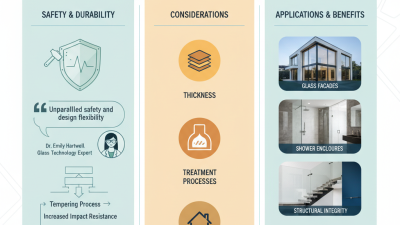
How to Choose the Right Toughened Glass for Your Projects?
Choosing the right toughened glass can greatly impact your project's success. As John Smith, a leading expert in the toughened glass industry, once said, "Selecting the right glass goes beyond aesthetics; it’s about safety and performance." This insight resonates deeply for architects and builders.
Toughened glass is known for its strength and resistance to thermal stress. However, not all toughened glass is created equal. Each project requires specific characteristics, such as thickness and clarity. Understanding these aspects can be complex.
Furthermore, many overlook the importance of certification. Reliable toughened glass must meet industry standards. Quality ensures durability and safety, giving peace of mind. Reflecting on past projects is vital too. Consider what worked and what didn't. Striving for the ideal choice can lead to better outcomes.
Understanding Toughened Glass: Definition and Manufacturing Process
Toughened glass, also known as tempered glass, undergoes a rigorous manufacturing process that enhances its strength. This glass is made through heating and rapidly cooling to increase durability. According to industry reports, toughened glass can withstand temperatures up to 300% greater than regular glass. This characteristic makes it suitable for various projects, from building facades to shower doors.
The production of toughened glass involves several key stages. First, the glass is cut into desired dimensions. Next, it is heated in a furnace to over 600 degrees Celsius. Rapid cooling follows, creating compressive stress on the surface. This method not only strengthens the glass but also increases its impact resistance. Interestingly, this process does not eliminate the risk of breakage; it merely reduces the chances. When broken, toughened glass shatters into small, blunt pieces, minimizing injury risks.
While toughened glass provides superior strength, selecting the right type for specific projects requires careful consideration. The thickness and type of glass, the intended use, and safety requirements all play crucial roles. Understanding these factors can greatly influence the performance and longevity of the glass in any application. Achieving the perfect fit may require adjustments, as not all installations come with a one-size-fits-all solution.
Key Properties of Toughened Glass: Strength, Safety, and Thermal Resistance
When selecting toughened glass for construction projects, understanding its key properties is essential. Strength stands out as one of the most critical factors. Toughened glass is about five to six times stronger than regular glass, withstanding significant impacts. According to a study from the Glass and Glazing Federation, even small panels can resist forces up to 1,000 Newtons without breaking. This makes it ideal for applications where safety is paramount.
Safety also plays a crucial role in the choice of toughened glass. When shattered, it breaks into small, blunt pieces, reducing the risk of injury. A report by the American National Standards Institute states that toughened glass is a preferred material in areas subject to high foot traffic or in public spaces. Additionally, its thermal resistance is noteworthy. Toughened glass can endure temperature changes of up to 200 degrees Celsius without cracking.
Despite its benefits, toughened glass is not flawless. Its production process can lead to internal stresses, which may result in unexpected breakage under certain conditions. It’s vital to understand these limitations when incorporating toughened glass into your designs. Not all applications may benefit from toughened glass, and careful assessment is necessary to ensure its efficacy in specific environments.
Industry Standards for Toughened Glass: EN 12150 and ASTM C1048
When selecting toughened glass, understanding industry standards is essential. The European standard EN 12150 specifies the performance requirements for toughened glass, outlining how the material should withstand stress and impact. A critical aspect of EN 12150 is the requirement for a minimum thickness, which varies based on application. For example, a 10mm thickness is often recommended for safety in facades and partitions.
On the other side of the Atlantic, ASTM C1048 governs the manufacturing and testing of toughened glass. According to this standard, the glass must achieve certain mechanical and thermal properties. Reports indicate that toughened glass under ASTM C1048 can withstand thermal shock better than regular glass, which is crucial in applications exposed to varying temperatures. However, the testing process can be complex, making it vital for manufacturers to adhere strictly to guidelines.
Choosing the right toughened glass involves evaluating both standards. Each project might have unique requirements influenced by local regulations and environmental conditions. Not every manufacturer may comply perfectly with these standards, thus requiring careful vetting. It's a mixed landscape—some will meet high-quality benchmarks, while others may not fully adhere to industry expectations, impacting safety and durability.
Applications of Toughened Glass in Construction and Design Projects
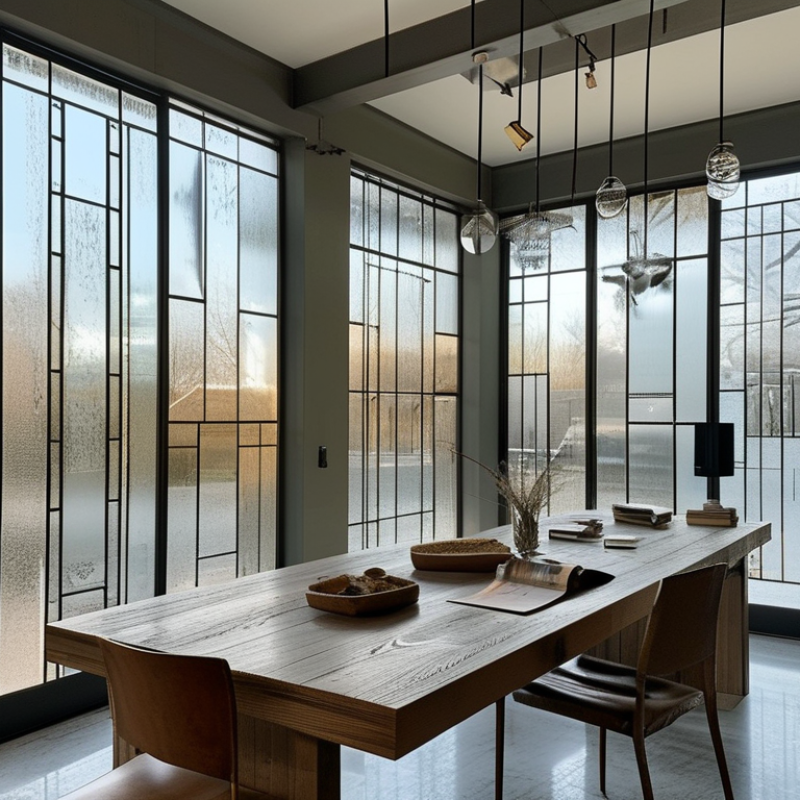
Toughened glass is increasingly popular in construction and design projects. This material is not only strong but also versatile. It can withstand high temperatures and impact, which makes it ideal for various applications. In residential and commercial buildings, toughened glass is often used for windows and doors. Architects love it for its aesthetic appeal.
In addition to windows, toughened glass is valuable in interior design. It is commonly used for shower enclosures and partition walls. The clarity and strength of the glass enhance the overall space. However, the installation process requires skilled professionals. Poor installation can lead to issues like thermal stress.
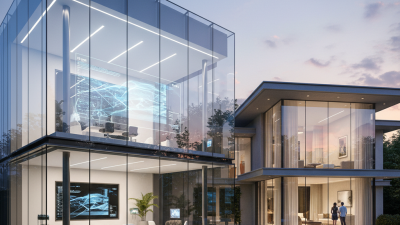
Another important use is in facades. Toughened glass can create stunning exterior designs while ensuring safety. The glass can be treated for reflective or tinted surfaces, contributing to energy efficiency. Despite its strength, there's a need to consider proper handling and maintenance. Scratches or chips may compromise the glass's performance. Always consult with experts to ensure the best practices are followed.
Selecting the Right Thickness and Type of Toughened Glass for Your Needs
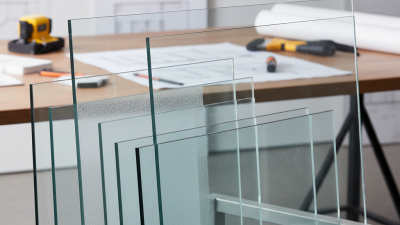
When selecting toughened glass, understanding thickness is crucial. Thicker glass offers increased strength, making it ideal for high-impact areas. For example, a 10mm thickness can withstand more force than a 6mm sheet. Always consider the specific requirements of your project, whether it's a shower enclosure or a glass partition.
Different types of toughened glass serve various purposes. Low-iron glass enhances clarity and is perfect for display cases. Heat-treated glass provides added thermal resistance, especially in kitchens. However, not all spaces require the same type. Evaluating your space and its demands will guide your choice.
One area where many falter is overestimating glass strength. Just because it’s toughened doesn’t mean it’s invincible. Regular maintenance is essential to avoid unexpected failures. Keep in mind, sometimes the best choice is a balance between aesthetics and functionality. Recognizing your needs is key.