Leave Your Message
Smart Side Windows are becoming an important consideration for vehicle makers and fleet buyers. These systems may use switchable glazing, electronic tint control, or integrated shading. The exact features vary by supplier. So does the meaning of “smart” in a product catalogue.
A useful supplier comparison goes beyond a polished brochure. Buyers should examine optical performance, response time, durability, power requirements, and compatibility with the vehicle’s electrical and interior systems. Ask for test documentation and clear operating limits. Check how suppliers handle prototypes, production volumes, quality control, and replacement parts. Small details matter. A control module that is difficult to integrate can delay a project, even when the glass performs well.
This overview introduces ten suppliers for global buyers to investigate, rather than declaring one universal winner. Suitability depends on the vehicle platform, target market, budget, and required technical support. Supplier capabilities also change, and public information may not cover every specification. That is worth remembering. Before committing, request current datasheets, sample evaluations, and written confirmation of relevant certifications and warranties. Compare like with like, and involve engineering and procurement teams early. A shortlist is only a starting point. Real-world testing may reveal trade-offs that a product page does not.
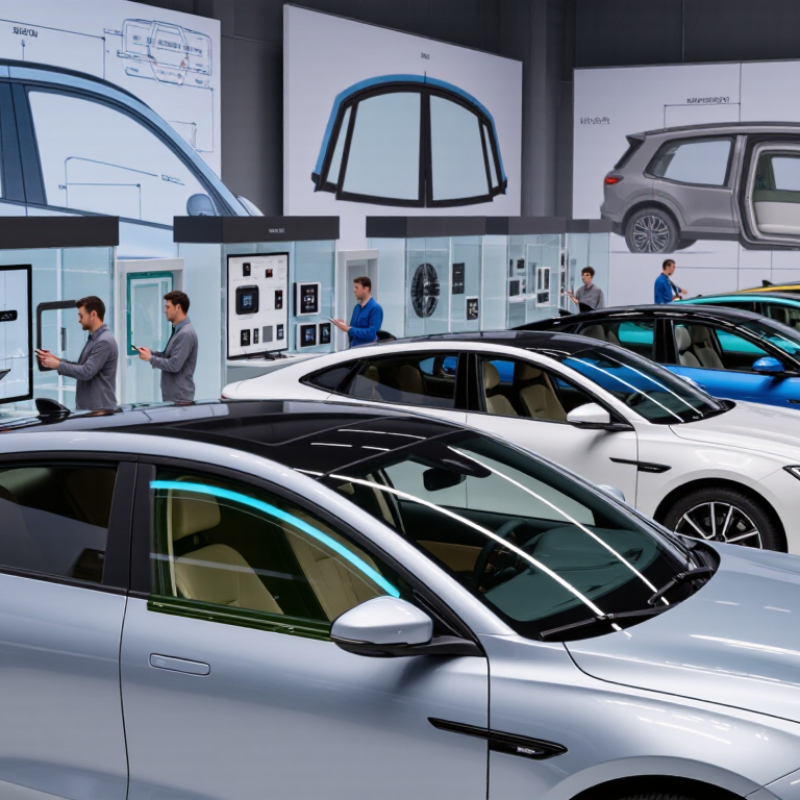
Smart side windows combine vehicle glass with electronic systems that adjust light, privacy, or both. The familiar glass may contain a switchable layer, conductive coatings, sensors, and control wiring. A driver might tap a door-panel button and watch the window change from clear to shaded. Response time and tint depth depend on the design.
Two common approaches work differently. Electrochromic layers darken when a low electrical current changes their optical state; some take several seconds to respond. Polymer-dispersed liquid-crystal layers can turn milky when powered, offering privacy but not necessarily blocking all light. These technologies are not interchangeable. Buyers should check measured light transmission, switching speed, and visibility under direct sun, rather than relying on labels alone.
Integration deserves close attention. Door glass curves, seals, wiring paths, and window regulators all affect performance. A poorly matched layer may create uneven shading or distracting reflections near the mirror. Ask for durability results after temperature cycling, vibration, and repeated switching, plus clear guidance on cleaning and repairs. One detail is easy to miss: a dark setting can reduce glare, but it may also limit the driver’s view at night. Real-world testing matters. Even good specifications can miss that.
Smart side windows use electrically responsive glazing, films, displays, or integrated controls to change light transmission or add functions. The entries below are supplier categories, not ranked or named companies. Technology availability and automotive qualification vary by product and application.
| Supplier Category | Typical Technology | How It Works | Potential Side-Window Use | Key Buyer Checks | Qualification Considerations |
|---|---|---|---|---|---|
| 1. Automotive glazing integrators | Laminated or tempered glazing with optional functional layers | Manufacture and process glass assemblies; optional films, coatings, sensors, or wiring can be incorporated into the system. | Production side glazing and vehicle-program integration | Glass geometry, optical quality, edge treatment, heater or antenna integration, and production capacity | Confirm applicable safety-glazing rules, vehicle-level validation, and traceability for the target market. |
| 2. Electrochromic glazing specialists | Electrochromic (EC) coatings or laminated glass | An applied voltage drives ion movement within a material stack, changing its light absorption and tint; switching is generally gradual rather than instantaneous. | Glare and solar-control concepts where controllable tint is desired | Tint range, switching time, power behavior, uniformity, low-temperature response, and durability | Verify cycle life, environmental testing, fail-state behavior, and compatibility with curved glazing. |
| 3. Suspended-particle device (SPD) suppliers | SPD film or laminated glazing | An electric field aligns suspended light-absorbing particles, allowing more light through; removing the field leaves the particles less aligned and the layer darker. | Variable light and solar control in suitable glazed areas | Visible-light transmission range, haze, power draw, switching behavior, and color neutrality | Check laminated-system durability, electrical connections, optical uniformity, and local approval requirements. |
| 4. Polymer-dispersed liquid-crystal (PDLC) film suppliers | PDLC switchable film or laminated glazing | With power applied, liquid-crystal domains align to make the layer more transparent; without power, light scattering typically gives it a translucent appearance. | Privacy or visual separation; not necessarily a substitute for dark sun-control tint | Haze, clear-state transmission, viewing appearance, drive voltage, and performance under sunlight | Assess privacy performance, edge sealing, moisture resistance, and whether the construction meets automotive requirements. |
| 5. Photochromic material suppliers | Light-responsive coatings or interlayers | Photochromic compounds change optical absorption in response to light exposure and return toward their original state as exposure changes; they do not generally require electrical switching. | Passive tint adjustment concepts, subject to the optical needs of the glazing location | Activation conditions, response and fading time, temperature sensitivity, and long-term color stability | Test performance across real vehicle temperatures and light conditions; confirm suitability for the intended glazing position. |
| 6. Thermochromic coating suppliers | Temperature-responsive coatings or films | Optical properties change as material temperature crosses a designed transition range; the response is passive rather than controlled by a switch. | Passive solar-management concepts where a temperature-dependent response is acceptable | Transition temperature, response consistency, reversibility, and optical performance over the operating range | Validate behavior in different climates and confirm that the response does not conflict with driver visibility requirements. |
| 7. Transparent-display and light-guide suppliers | Transparent display layers, projection surfaces, or embedded light guides | Display elements or guided light create information visible through or on a glazing assembly; the display function is distinct from tint-control technologies. | Information or ambient-light concepts, subject to visibility and distraction limits | Daylight readability, transparency when inactive, viewing angles, heat, wiring, and content controls | Review driver-distraction rules, optical distortion, electromagnetic compatibility, and system-level safety. |
| 8. Functional-film and interlayer converters | Optical films, conductive layers, and glazing interlayers | Convert, laminate, or combine material layers that provide optical, electrical, acoustic, or protective functions within a glazing assembly. | Enabling components for switchable glass and multifunctional windows | Adhesion, optical distortion, UV stability, thickness tolerance, and compatibility with glass and active layers | Request material data, lamination process windows, aging results, and evidence of compatibility with the full stack. |
| 9. Vehicle electronics and control-system integrators | Window controllers, sensors, wiring, and vehicle-network interfaces | Power electronics and control logic regulate an active glazing layer and may connect it to switches, sensors, or vehicle systems. | Control and integration for electrically switchable side windows | Voltage and current limits, diagnostics, electromagnetic compatibility, software interfaces, and safe default state | Check vehicle electrical architecture, functional-safety needs, fault handling, and serviceability. |
| 10. Specialty vehicle-glazing fabricators | Custom laminated glazing and integrated film assemblies | Fabricate glazing to application-specific shapes and may combine conventional glass processing with third-party active films or components. | Buses, coaches, specialty vehicles, low-volume programs, or custom replacement applications | Prototype capability, dimensional control, repair process, minimum order quantity, and supply continuity | Confirm that the complete assembly—not just the film or glass—meets applicable safety and durability requirements. |
Note: “Smart side window” can refer to tint-changing glazing, privacy glazing, or display-enabled glazing. These functions use different technologies and are not interchangeable. Buyers should evaluate the complete glass-film-electronics assembly against the applicable vehicle and regional requirements.