Leave Your Message

China Best Bent Glass Supplier for Global Buyers?

Choosing the China best Bent Glass supplier requires more than comparing factory prices. Global buyers need verified quality, stable production, and documented project experience. Bent Glass appears in façades, shower enclosures, railings, skylights, and curved furniture panels. Each use demands different control over radius, thickness, optical distortion, and edge finishing.

Industry data supports this demand. Grand View Research identifies flat glass as a large global construction material market, supported by building renovation and energy-efficiency projects. The International Energy Agency reports that buildings account for about 30% of global energy demand. This strengthens interest in low-emissivity coatings, insulated units, and high-performance curved glazing. However, curved processing can reduce yield. A supplier should explain its heating curves, mold accuracy, tempering process, and inspection standards.

Look beyond brochures.

A reliable Chinese manufacturer should provide test reports, sample approval records, production photographs, and clear tolerance data. EN 12150, ASTM C1048, and related standards may apply, depending on the destination market and product design. The right supplier also confirms packing methods, container loading plans, replacement procedures, and after-sales communication. These details matter when a curved panel arrives with edge damage or unexpected visual distortion.

No supplier is perfect. I would question any company promising zero defects, unlimited shapes, and the lowest price simultaneously. A stronger evaluation compares technical drawings, pilot samples, coating performance, lead times, and inspection evidence. Reports from Statista, Grand View Research, and the IEA provide useful market context, but factory verification remains essential. For global buyers, the best Bent Glass supplier is the one that can repeatedly turn complex specifications into safe, traceable, and installation-ready products.
China Best Bent Glass Supplier for Global Buyers?

What Makes China a Leading Source of Bent Glass

China’s Leading Source of Bent Glass

China has become a major source of bent glass because it combines large-scale production with flexible fabrication. The National Bureau of Statistics recorded about 965 million weight cases of flat glass output in 2023. This industrial base supports access to float glass, furnaces, molds, laminating lines, and export packaging.

Scale matters, but it is not proof of perfect quality. The Grand View Research report valued the global architectural glass market at approximately USD 115.3 billion in 2022. It also forecast a 6.7% compound annual growth rate from 2023 to 2030. Chinese processors serve this expanding demand with curved façades, shower panels, railings, and vehicle-related applications. Experienced buyers still check radius tolerance, edge finishing, optical distortion, heat treatment, and interlayer performance. A beautiful sample can hide weak process control.

Tips: Request a technical drawing before pricing. Confirm the inside radius, thickness, glass type, tolerance, and packing method. Ask for inspection photos from the furnace exit and crate loading. Small details matter. A supplier may quote quickly, yet the mold cost, breakage allowance, and export packaging may be unclear. Independent inspection is not excessive for large orders. It can reveal scratches, roller-wave distortion, or incomplete edge polishing before shipment. Availability also varies by project size, so standard dimensions may offer better lead times than unusual curves.


How Bent Glass Is Designed and Manufactured

China’s bent glass industry serves global buyers through controlled design, skilled processing, and documented inspection. The real work begins before the furnace is heated. Designers study opening sizes, curvature, thickness, edge conditions, and the glass’s final location. A drawing may look simple. Thermal stress can make it difficult.

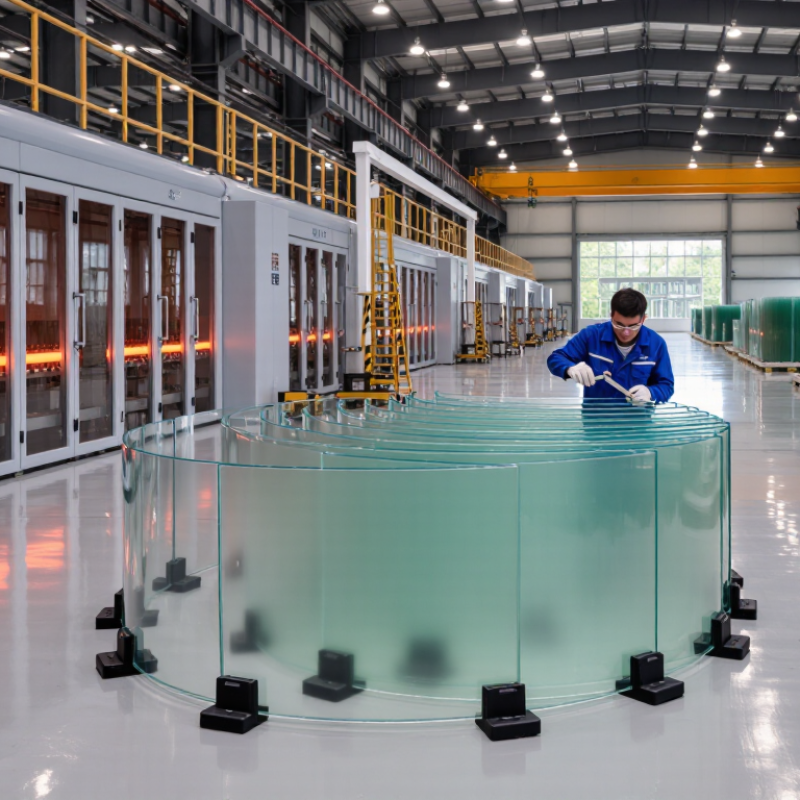
Engineers usually create a digital model and confirm the bending radius with production specialists. They may build a trial mold from steel or heat-resistant material. The glass is cut oversized, shaped at its edges, and heated gradually in a bending furnace. Gravity bending suits smooth curves, while press bending can support tighter forms. Cooling is carefully controlled to reduce internal stress and distortion.

Not every first sample is perfect. Small deviations happen. A careful manufacturer records them, checks the mold, and adjusts the heating curve or forming pressure. This practical feedback often matters more than attractive specifications. After bending, technicians inspect optical quality, dimensions, edges, and surface marks under suitable lighting. Tempering, heat strengthening, or lamination may follow, depending on the project’s safety and performance needs. Clear inspection records, sample approval, and traceable batch information help buyers assess reliability. Poor communication remains a common weakness, especially when drawings omit tolerances or installation details. Experienced teams ask questions before production, not after a rejected shipment.

Key Standards for Evaluating Bent Glass Suppliers

China Best Bent Glass Supplier for Global Buyers?

Choosing a bent glass supplier requires more than comparing prices. Start with manufacturing experience. Ask how the supplier handles radius control, edge finishing, heat treatment, and complex shapes. A capable factory should explain its process clearly, not hide behind general claims.

Review technical standards carefully. Confirm glass thickness, bending radius, dimensional tolerances, optical quality, and thermal performance. Request inspection records and test reports from recent production batches. Reliable suppliers should support traceability from raw glass to final packing. Check whether their equipment suits your volume, especially for large panels or repeated curves. Samples matter. A sample may look excellent, but production consistency can still fail. This is where many buyers underestimate risk.

Tips: Compare samples under daylight and angled lighting. Inspect edges by touch. Ask for a written tolerance sheet, packing drawings, and a replacement policy. Confirm communication times before signing an order. Visit the factory when practical, or request a live video inspection. No supplier is perfect. Even experienced teams can misread a drawing or miss a small distortion. Honest suppliers explain possible limits and suggest workable adjustments. Their response to a problem often reveals more than their sales presentation. Look for documented quality control, trained inspectors, secure export packaging, and realistic delivery schedules. A dependable partner welcomes detailed questions and provides evidence, not impressive promises.

China Best Bent Glass Supplier for Global Buyers?

Key Standards for Evaluating Bent Glass Suppliers

This buyer-focused evaluation model assigns suggested importance weights to the main areas that affect bent glass supplier performance. Review evidence such as ISO 9001 quality systems, applicable safety standards including EN 12150, EN 12600, ANSI Z97.1, ASTM C1048, or local equivalents, dimensional inspection records, optical quality controls, and export packaging procedures.

How Global Buyers Select the Right Chinese Supplier

China Best Bent Glass Supplier for Global Buyers?

Global buyers should evaluate process control, not attractive catalogs. Bent glass quality depends on furnace accuracy, mold design, cooling speed, and edge finishing. A 2024 Grand View Research outlook identifies construction as a major driver of global glass demand through 2030. That growth increases supplier choices, but not necessarily supplier reliability.

Ask for production samples matching your required radius, thickness, color, and coating. Measure optical distortion under consistent lighting. Inspect the edges closely. They matter.

A qualified Chinese supplier should provide tempering records, heat-soak documentation when required, and test reports aligned with EN, ASTM, or GB standards. Reports from recognized laboratories add credibility. Request batch traceability, inspection photos, and a clear replacement policy before placing an order. ISO 9001 certification can support process confidence, although certification alone proves little. I would not trust a polished certificate without recent production evidence.

Logistics also deserve careful review. The 2023 UN Comtrade data shows China remains a leading global exporter of glass products, creating strong shipping experience among many manufacturers. Still, bent panels need custom crates, corner protection, moisture control, and accurate container loading plans. Confirm maximum dimensions and allowable breakage in writing. Compare total landed cost, not only the factory quotation. A low quote may hide weaker packaging or inconsistent tolerances. No checklist is perfect. Small trial orders often reveal communication gaps before a major project exposes them.

China Best Bent Glass Supplier for Global Buyers? - How Global Buyers Select the Right Chinese Supplier

Selection Dimension Common Buyer Benchmark What Buyers Should Verify Suggested Weight
Applicable safety-glass standard Compliance with the standard specified for the destination market, such as EN 12150 for thermally toughened glass, ASTM C1048 for heat-treated flat glass, or relevant local building regulations. Current test reports, certificates, product markings, and traceable batch records that match the actual glass type and thickness. 20%
Glass configuration Clear, tinted, low-emissivity, laminated, insulated, or other specified configuration; commonly ordered thicknesses include approximately 4–19 mm, subject to the supplier’s forming and tempering capability. Written confirmation of glass composition, coating position, interlayer type, thickness tolerance, and compatibility with bending and heat treatment. 12%
Radius and geometric accuracy The minimum radius, arc length, angle, rise, edge position, and dimensional tolerances must be confirmed against approved technical drawings. Minimum radius is equipment- and glass-dependent rather than universal. A measured prototype, dimensional inspection report, calibrated equipment records, and documented tolerance limits for each critical dimension. 15%
Optical quality Low distortion, uniform curvature, acceptable roller-wave level, minimal anisotropy, and no visible scratches, chips, cracks, or unacceptable inclusions in the agreed inspection zone. Pre-shipment inspection under defined lighting and viewing conditions, approved visual samples, and objective acceptance criteria. 14%
Mechanical and thermal performance Heat-treated products should meet the required fragmentation, surface-stress, thermal-strength, and safety-performance requirements for the selected standard. Test results from the supplied production batch, heat-treatment records, fragment-pattern evidence where applicable, and quality-control sampling plans. 15%
Fabrication capability Ability to process holes, notches, cut-outs, polished edges, ceramic frit, laminating, insulating units, and other operations before tempering or bending when required. Machine capability list, sample parts, process sequence, maximum workable dimensions, and confirmation that fabrication occurs before tempering where required. 10%
Production capacity and consistency Stable capacity for prototype, pilot, and repeat orders, with consistent results across batches and documented corrective-action procedures. Capacity statement, recent production samples, inspection records, quality-management procedures, and contingency plans for equipment downtime. 8%
Packaging and export protection Strong export crates, separators, edge protection, moisture control where needed, clear crate labeling, and loading methods suitable for large or curved glass. Packaging drawings, photographs of completed loading, crate material details, shock-risk controls, and responsibility for damage claims. 6%
Lead time and delivery control A written schedule covering drawing approval, tooling or setup, sample production, mass production, inspection, packing, and shipment. Purchase-order milestones, production updates, inspection release procedure, shipping documents, and agreed remedies for delays. 5%
Commercial value and after-sales support Competitive total landed cost, transparent tooling or setup charges, clear warranty terms, responsive technical communication, and a defined claim-resolution process. Itemized quotation, Incoterms, payment terms, warranty exclusions, response times, replacement policy, and records of corrective actions. 5%
Total evaluation weight 100%

Note: Technical limits and acceptance criteria vary by glass type, equipment, project drawings, destination-market regulations, and applicable standards. Buyers should approve a physical sample and written inspection specification before mass production.

Shipping, Quality Control, and After-Sales Support for Bent Glass

China Best Bent Glass Supplier for Global Buyers?

Shipping, Quality Control, and After-Sales Support for Bent Glass

Buying bent glass from China requires more than comparing unit prices. The supplier should understand radius, thickness, edgework, and the final installation environment. Experienced teams confirm drawings before production. They also check whether the glass suits doors, façades, railings, or curved furniture.

Shipping protection starts with dry, strong crates and stable internal supports. Each panel should have separators that prevent glass-to-glass contact. Moisture control matters during long sea journeys. Crate markings should show lifting points, panel numbers, and handling direction. A practical supplier shares loading photos, packing lists, and inspection records before dispatch. Small omissions can create expensive delays.

Quality control should include dimensions, curvature, surface defects, edge condition, and safety performance. I prefer inspection records linked to each crate, not only general factory statements. Samples should be reviewed before mass production. However, no supplier gets every shipment perfect. Even careful teams may miss a minor edge mark or packaging weakness. That risk needs an honest response plan.

After-sales support should remain available after delivery. The team should respond with photos, measurements, and replacement options when damage occurs. Clear claim procedures save time. A reliable supplier investigates the cause instead of blaming installation immediately. Sometimes the problem is shared: packaging, transport, or site handling may all contribute. Regular communication makes correction more realistic for global buyers.